Interaction Design: Lighthouse, Port, City
(Attract, Engage, Commit)
Interaction Design shapes every community gathering by the depth it's built to create.
Interaction Design is the practice of designing every interaction in a community according to the depth of relationship it is meant to create, organised by the Lighthouse, Port, City funnel — attract, engage, commit. It gives every gathering a job rather than just a date in the calendar, and it answers the question most community calendars never ask: what is this specific thing for?
We usually start conversations with the what. What do you do? What's your name? What brings you here? The what is a conversation starter. It gets us in the room — and in the long run it matters far less than the why that keeps us there.
What is the Lighthouse, Port, City framework?
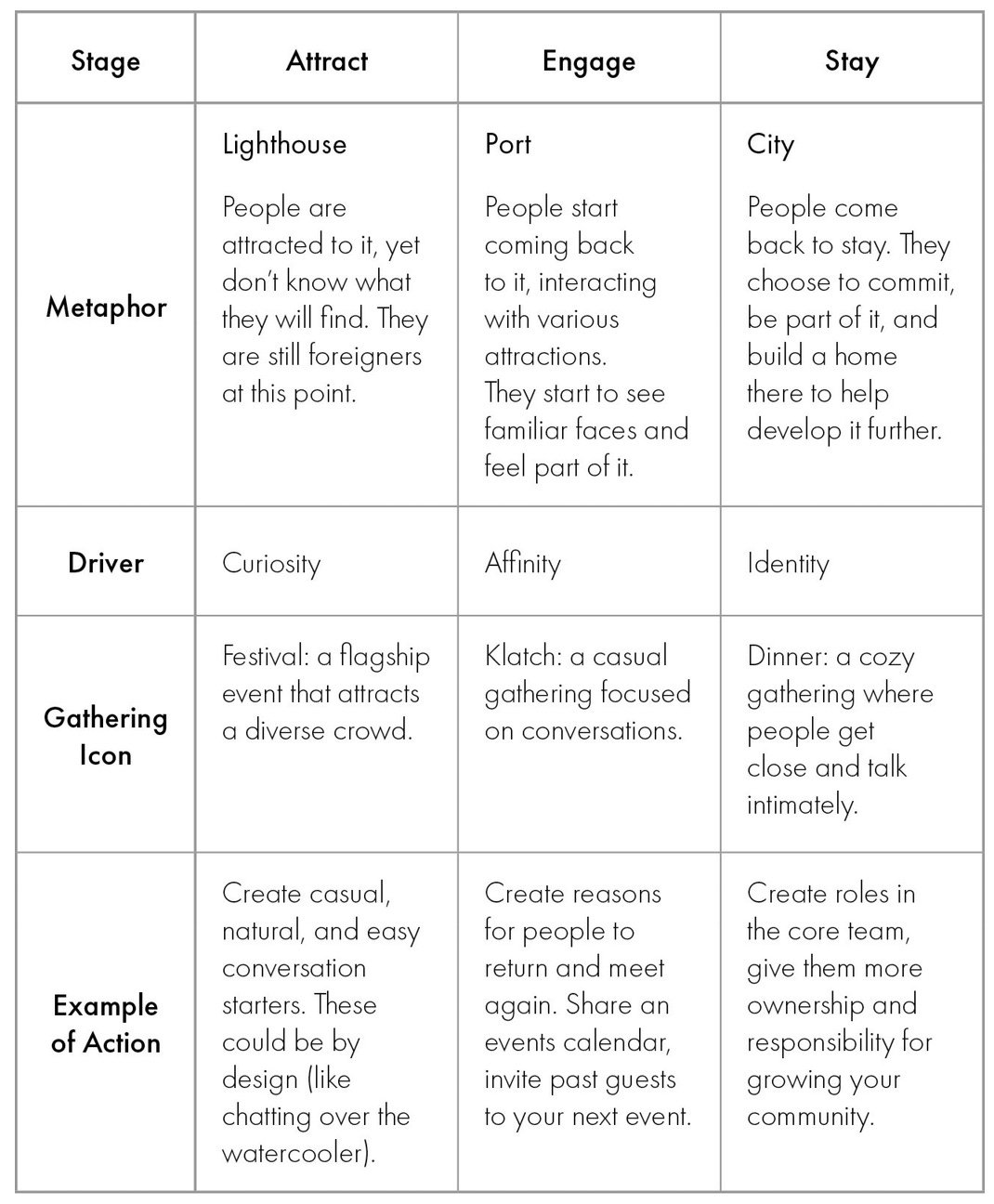
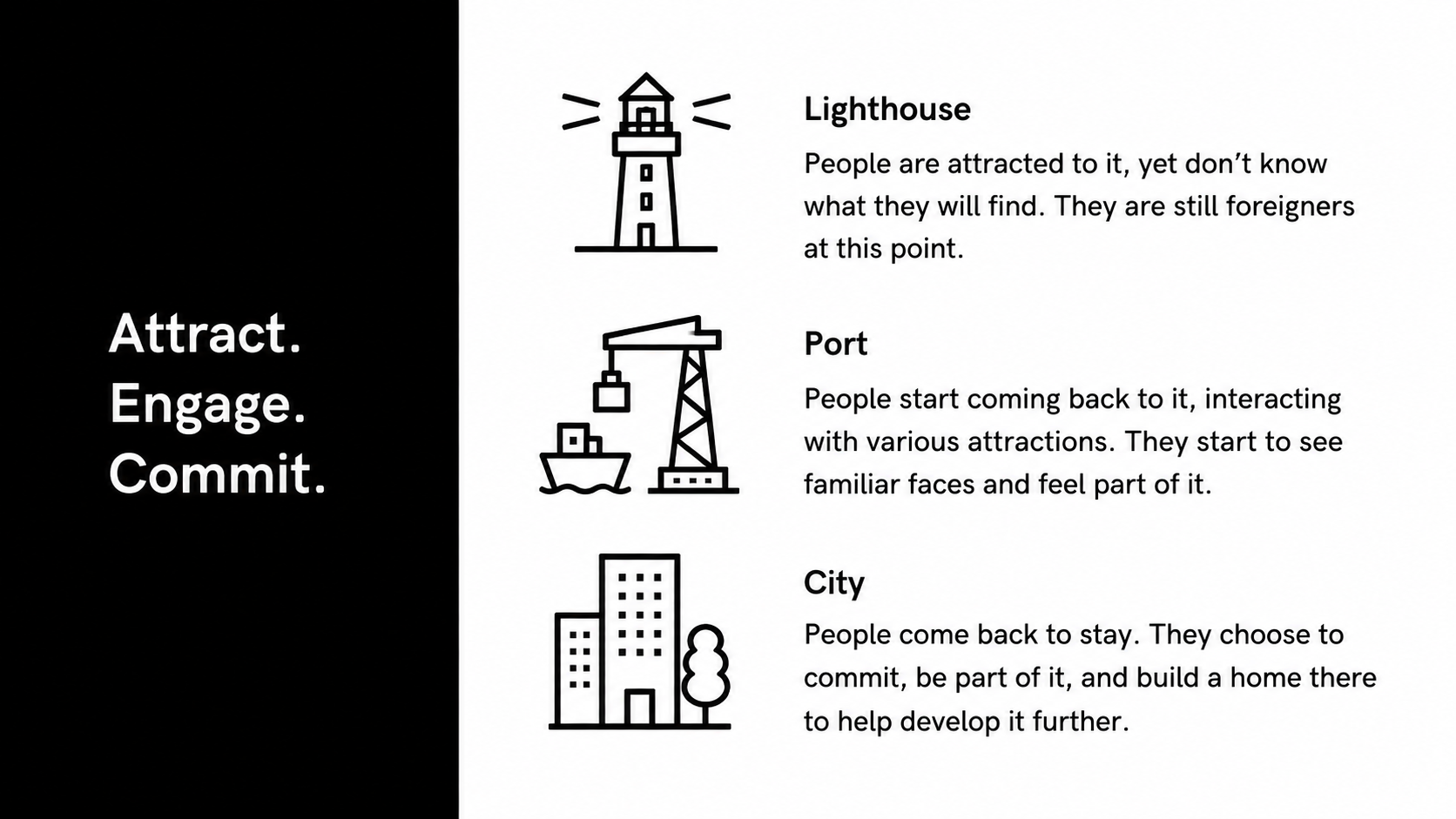
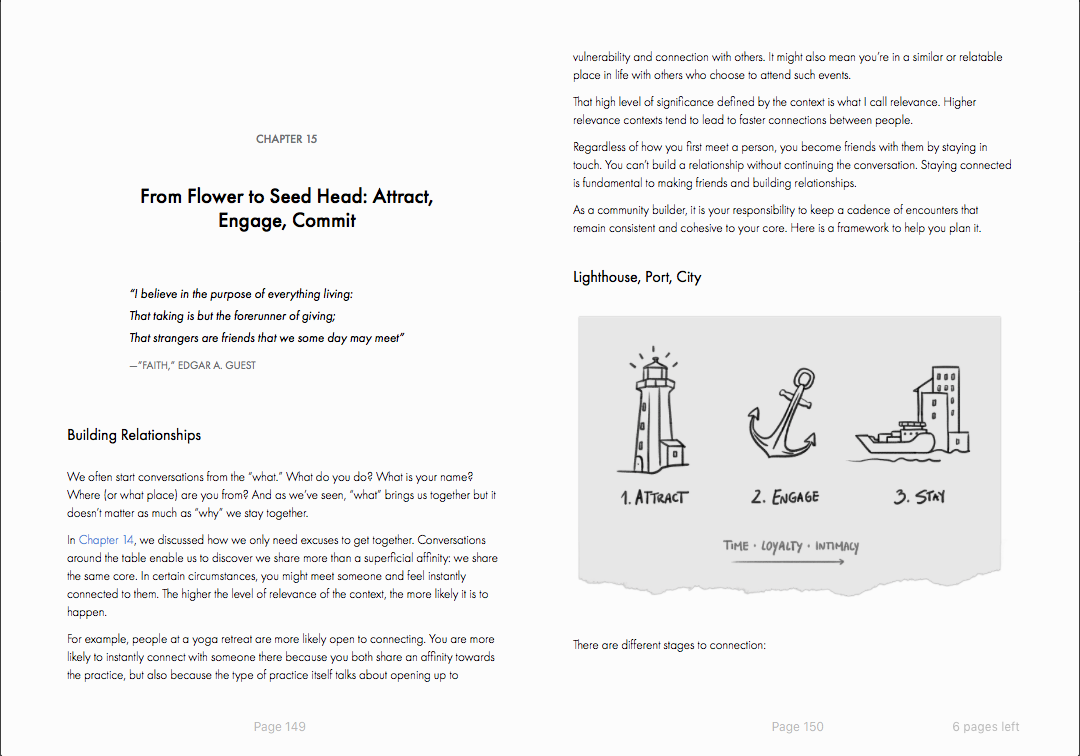
Lighthouse, Port, City is a three-stage funnel that sorts everything you do to bring people together by the stage of connection it serves. There are three stages to any bond forming: what first makes you aware of someone, what makes you meet again and more often, and what makes you stay and commit. The framework uses the metaphor of a ship at sea finding a Lighthouse, docking repeatedly at a Port, and eventually settling in a City.
It is the same shape as any personal relationship, multiplied — and with yourself deliberately taken out of the equation, by building systems that let people connect without you in the middle. Flirting, dating, and then committing. Attraction, engagement, commitment.
I built it to solve a practical problem: how to deepen connections at a scale where I couldn't personally introduce everyone. Every gathering, piece of content, or product you make belongs to one of the three stages. Once you can say which, you can tell whether your calendar is balanced or whether you've been doing the same thing over and over and calling it a community.
What happens at the Lighthouse stage?
The Lighthouse is the attraction stage: like a beacon guiding ships at sea, its job is to attract people and make you a reference in your cause, industry, or area of impact. Lighthouse activities reach a wide audience while still relating to your core, and for most of your community they will be the very first interaction — which makes this the stage that builds your brand.
Large music festivals. Industry conferences. Hackathons. Cultural gatherings.
These pull in a wide range of people who share an interest at wildly different levels of commitment — hundreds or thousands of them, some of whom will feel an instant connection to your core and most of whom won't.
The Lighthouse has exactly one goal: get a high percentage of those people to the Port. Lighthouse programming only makes sense if you have a strategy for engaging them afterwards.
It is also the best tool you have for designing in diversity. Attraction is where you can deliberately reach beyond your own networks and break your social bubbles. It's worth occasionally running something odd enough to wildly diversify who shows up.
And if your why is too deep to explain in the few seconds attraction gives you — keep it fun and memorable instead.
A charitable event at a candlelit concert.
A wine tasting hosted by a secret sommelier.
Attract from curiosity and affinity; you'll have their attention for the real conversation later.
What happens at the Port stage?
The Port is the engagement stage: it gives people a place to come back to, and its job is to turn attention into familiarity through repetition. People often return to a port for entirely different reasons than the ones that first drew them there. Over time we start to notice faces we've seen before, we feel familiar with the place, we greet people who used to be strangers, and the conversations get more personal. We start to feel at home.
Private dinner series for regulars. A newsletter or interactive platform. A shared calendar of activities that narrow the interest and connect a genuine niche.
The purpose of the Port is to build relationships with the people who share your core most, until closeness becomes belonging. It's also where the line gets blurry — so define it clearly: the Port begins when someone becomes an active regular rather than someone lurking around events and discussions.
This is the hardest stage, and the one most often skipped. It requires showing up at a predictable cadence, in the same way, over and over. That's what Chapter 14 calls the 3 Cs — consistency, cadence, and cohesion.
What happens at the City stage?
The City is the commitment stage: a place where people live, surrounded by opportunities and by others who make them feel at home. It's when someone decides to stay and take an active role — becoming a crucial part of the community rather than a participant in it.
Attracted by a lighthouse, they found reasons to return to a port, met people and places that felt good, built relationships and memories, and eventually invested in a city. They felt at home and decided to stay.
Advocacy and ambassador programmes.
Referral programmes where members drive growth directly.
Roles that let members lead — including starting a chapter of your community in a new city.
This is the stage of active contribution, where you create roles for people to add concrete, direct value. It means trusting them, delegating, and equipping them with knowledge and tools so they can fly out, spread the word, and grow the thing without you. It has to be reciprocal: at this stage you are building close relationships with the people you trust most, and they can tell whether the trust runs both ways.
The City is also where people most often assume the work is finished. It isn't. This stage takes as much effort as the ones before it. Never take anyone's commitment for granted — keep making encounters that keep the fire up, using the what that attracted them in the first place to keep recalling the why that keeps you together.
Do people always move through the stages in order?
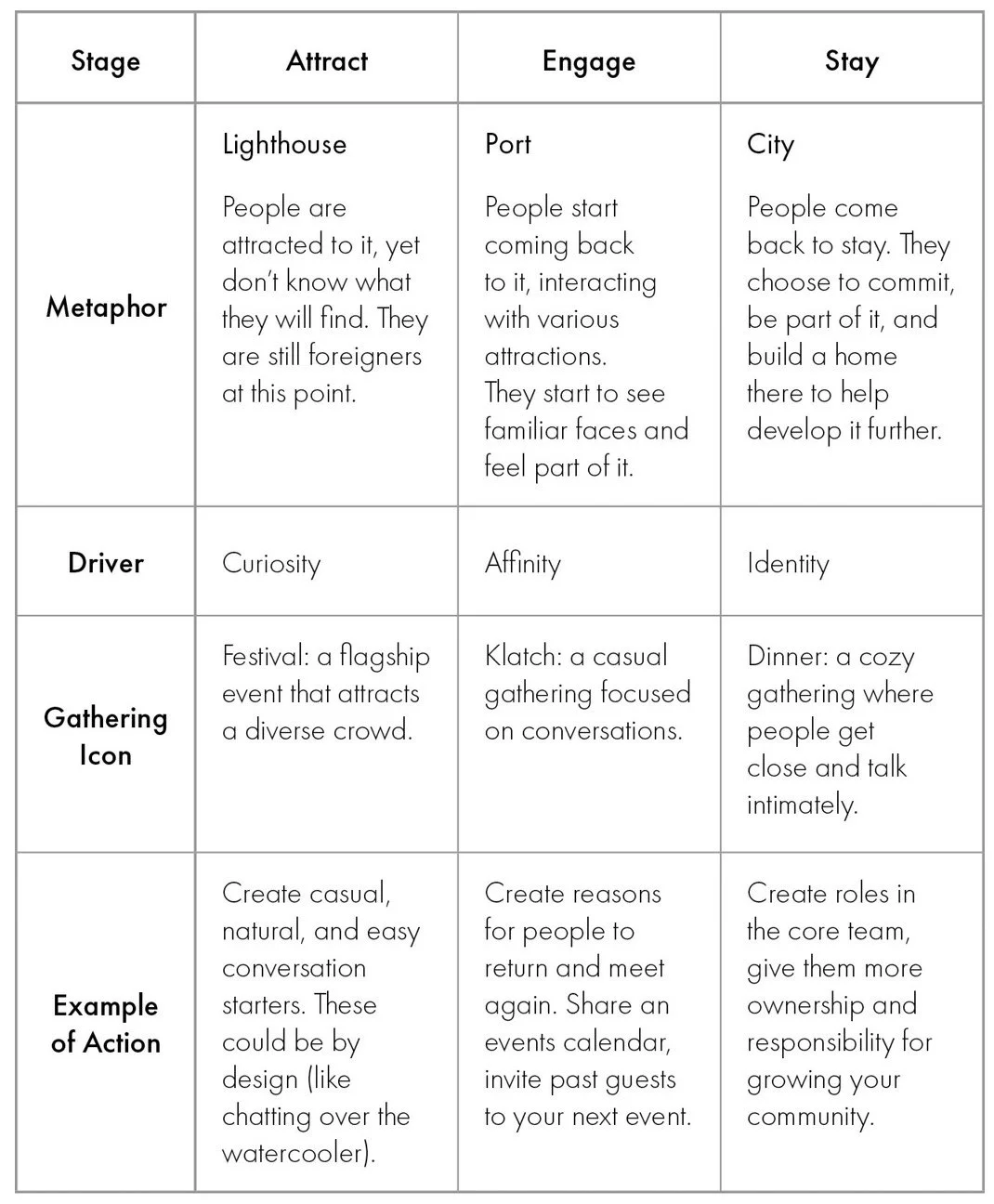
Short answer is: no. The process is messier than the diagram, and it's a funnel, so not everyone is meant to make it through. Some people will look at your Lighthouse activities and never come back. Some will engage at the Port and never commit. That's fine, and designing as though it weren't is how you end up resenting your own community.
People also skip stages. Someone invited by an existing member can arrive straight into the Port, and that's more likely if they're already active in adjacent communities. What you can't do is skip building a stage. If there's no Port, the people your Lighthouse attracts have nowhere to land.
One rule holds across all three: stay cohesive. Every word, action, and piece of content should align with your core, at every stage. People notice the seams even when they can't name them.
What's the most common mistake in Interaction Design?
The most common mistake is getting stuck at the Lighthouse. The attraction stage is genuinely fun, it's visible, and it produces numbers you can report — so organisers keep running Lighthouse-style activities to grow the crowd, without ever building the more intimate spaces that connect the community they already have.
A bright Lighthouse and no Port produces an audience, not a community: a lot of people who know your name and none who know each other.
The discipline is to keep moving people closer after each stage, and to prioritise the ones who care enough to stay in touch and contribute. The only goal of attraction is engagement. The only purpose of engagement is commitment.
Why do some connections form much faster than others?
Connections form faster in high-relevance contexts, and relevance is something you can design.
Think of the difference between a yoga retreat and the average professional networking event.
People at the retreat are far more likely to connect deeply, partly because they share an affinity for the practice, but mostly because the activity itself involves openness, vulnerability, and connection with others. Attending something like a retreat also tends to signal a real commitment to yourself, which means it gathers people in similar moments of transition.
Relevance comes from sharing more than one criterion of identity. But the most important criterion by far is a shared purpose: which includes both a shared journey and a destination.
The practical consequence is that curation beats reach. The more curated and niche the gathering, the more likely people are to connect meaningfully on the very first encounter.
The more mass-oriented it is, the more you'll need facilitated programmes and recurring gatherings to get the same result over time. You could host something for mothers, which is broad — or for first-time mothers who work and live abroad, which is narrow, and which will produce far better conversations.
You are more likely to share a personal story with a stranger at your closest friend's dinner party than with one in a supermarket aisle, over cans of soup.
Who is a community actually for?
Communities are made of people in transition: people trying to get from A to B. And the more intense the transition, the more the community is needed. Big transitions surface deeper questions and more critical moments, which creates more opportunity for people to bond over similar experiences. Sharing those requires vulnerability, which requires embedded trust, which requires familiarity built through interaction — the whole chain you reverse-engineer when you build a community.
Community is what happens on the way from A to B.
This is the most useful filter I know for deciding who to design for. Not a demographic, not a job title — a shared crossing. Ask what transition your people are in the middle of, and the rest of the design follows: what would help them get there faster, or at least make the road more pleasant, in the company of people making the same journey.
Where should you invest first: your core or your edges?
Start with your strongest bonds. Silversmithing taught me this better than any community theory did. A single piece of jewellery can contain several soldered joints, and solder comes in three types — hard, medium, and easy — each with a different melting point. You use hard solder on the first joint, medium on the second, easy on the third. Do it in that order and each new joint can be made without re-melting the ones already set. Get the order wrong and adding a new piece destroys the work you've already done.
Communities behave exactly the same way under heat.
The practice comes down to three moves:
Design first. Know roughly what the finished piece looks like before you make the first joint: which relationships and interactions are structural, and which are decorative.
Start from your strongest bonds. Those are the joints that have to survive every later addition.
Hard solder first, easy solder last. A solid base lets the piece grow in complexity without losing its integrity.
Which means: more nurturing, less outreach. The attractiveness of a community is built by its people, not by constant advertising: by relationships, not transactions.
Companies chase the next shiny object the way people at a party chase the next most interesting person in the room, and both take for granted the relationships already holding the thing up. The stronger the ties within your core, the further it can ripple outward, and the more appealing it looks to everyone outside it. Communities grow through the very relationships that sustain them.
How is Lighthouse, Port, City different from a marketing funnel?
A marketing funnel moves a person toward a transaction; Lighthouse, Port, City moves them toward ownership. In a marketing funnel, the value flows one way and the bottom is where someone buys. In the City, value increasingly flows between members rather than from you to them, and the bottom is where someone starts building things you didn't ask for.
There's a structural difference too. A marketing funnel is finished when the conversion happens. This one never finishes — the City requires as much work as attraction did, because commitment is a relationship rather than a status. We are never done in community building.
Recommended read: Community Architecture, Closeness Circles.
How this connects to the other frameworks
The Core Values of Community — cohesion across all three stages means the same values show up at the Lighthouse and in the City. People notice when they don't.
Community Design: the 5 Ps — Programming is what you run; Lighthouse, Port, City is how deep each thing is built to go. Platform is usually where the Port lives.
Closeness Circles — the people-side counterpart. Lighthouse reaches your Network and Crowd, the Port deepens your Inner Circle, the City belongs to your Core.
Engineering Serendipity — Interaction Design decides what kind of gathering this is; Engineering Serendipity decides whether anything actually happens inside it. Frequency, density, catalyst.
The Member Success and Contribution Journey (and Lifecycle) — the City is where contribution becomes a role. The Journey is how someone gets there and how long it takes.
The Dandelion Lifecycle — Lighthouse, Port, City is the framework for the Flower to Seed Head stage, when a community is large enough to need a funnel at all.
Adapted from Chapter 15 of Hacking Communities: Cracking the Code to Vibrant Communities by Laís de Oliveira. Also published in Portuguese as Reinventando Comunidades. The soldering metaphor first appeared inHard solder first: what silversmithing taught me about scaling communities.
Last updated: 19 August 2026
The Original Essay (Archive)
Attract > Engage > Commit
The Relationship-Building Framework: Lighthouse, Port, City
There are three stages to connection:
What attracts people at first (e.g., an invitation or a conversation starter)
What gets them engaged, making the meet again and more often (e.g., "we should do this again soon," or "let's grab coffee/dinner this week?")
What makes them stay connected and build close relationships (as friends, partners in business or life)
To deepen connections at a scalable level, I crafted this simple funnel framework to help me design and organize how I bring people together according to their connection stage.
Using the metaphors of Lighthouse, Port, and City.

Lighthouse (Attraction)
Like a beacon that guides ships at sea, your goal is to attract and become a reference within your cause, industry, or area of impact. Lighthouse content, events, or products are often your first interaction with most of your community, playing a key role in building a brand.
Examples:
Large music festivals (Coachella);
Massive boot camps (Hackathons);
Industry-based conferences (Web Summit).
These events attract a wide range of people who share a similar interest at different levels of commitment. They attract hundreds to thousands of individuals who might or not feel instantly connected to your core.
This stage aims to attract people and lead a high percentage of them to the next stage, the Port, where they will be engaged and find reasons to come back.
Port (Engagement)
Give people a place to come back to. We might come back to a port for different reasons than the initial attraction that got us there. This stage aims to build engagement through content, program, or activities that bring people to dive deeper and feel closer to your core (values, principles, and purpose). It is all about getting to know each other better and more profoundly.
Over time, we start to notice people we've seen before and feel familiar with the place. We create memories around it, greet those who used to be strangers, have more intimate conversations, and start to feel at home.
Examples:
Private dinners series for active members and regulars;
Platforms and interactive content (e.g., newsletters);
Shared calendar of activities, discussions, or events that further curate and narrow down interests to connect a niche audience.
This stage is about engagement: you're giving people recurring reasons to return until they feel like they belong.
The purpose is to build relationships with people who share your core the most, building closeness over time until it becomes belonging.
City (Commitment)
A place where people live, where they are in touch with a vast world of opportunities and people who make them feel at home. This stage is about commitment: it's when people decide to stay and play an active role in your community, becoming a crucial part of it. Attracted by a lighthouse, we found reasons to return to a port where we met interesting people and places that felt good. Over time, we build close relationships and memories that make us feel like we belong. We went beyond the Port, investing in a City. We felt at home and decided to stay.
Examples:
Advocacy programs (e.g., ambassadorship)
Referral programs (e.g., members directly contributing to growth)
Creating roles for community members to contribute (e.g., members taking on leadership roles or starting a new chapter of your community in a different city)
This is the stage of active contribution when you create roles for people to add concrete and direct value to your community.
It is about creating roles for active people to hop in and making space for them to take responsibility and be part of growing your community beyond merely participating in it. By trusting them, delegating roles, and empowering them with knowledge and tools, they can fly out, spread the word, and help you grow.
It is important to note that, at this stage, you must build close relationships with those you trust most on a reciprocal basis.
This stage aims to multiply your potential to grow your community through the contribution of your most committed members.