The Community Success Journey: Guiding People from Newcomers to Top Contributors
The Community Success Journey guides members through contribution toward success. It maps how someone travels from newcomer to top contributor: the path, the timing, and the value ladder that makes each step possible.
The Community Journey is a framework for guiding a member from newcomer to top contributor, made of three parts that only work together: the Contribution Journey is the path a person travels, the Contribution Lifecycle is how long that travel takes, and underneath both sits a value ladder — what your community delivers at each stage, where every level rests on the one below it. It exists because contribution is something you design for, not something you hope for.
I developed both from Chapter 17 of Hacking Communities to make the Closeness Circles usable by a team. The Circles show you the layers. The Journey shows you how a specific person crosses them, and what they need at each threshold.
Why should members do the work?
Because in a community, the participants are the ones who create its intrinsic value — so the job has to be done by them. In a business context that means enabling users and customers to create value for each other.
Their job is to create value. Yours is to enable high-value interactions between them.
Clayton Christensen's Theory of Jobs to Be Done says we "hire" a product to get a job done, and fire it when it doesn't. Translate that to community: if your organisation offers community as part of the solution, you have to activate members' participation to solve the problem named in your promise. The Job to Be Done must be, at least in part, done by your members.
The organisations that are genuinely community-led understand this.
From HubSpot, Waze, and Duolingo to Taylor Swift, they turn customers, users, and fans into participants — and then get out of the way. As Vivian Reidler, who spent eight years designing Duolingo's product community, puts it: users are not your employees; you can't tell them what to do. You need a system that encourages them.
What makes contribution actually relevant to member success?
Contribution is relevant to member success when it passes three tests: alignment with your core value proposition, systemic participation rather than self-service, and relationships rather than transactions. Without all three you get activity that looks like community and delivers nothing.
It aligns with your core value proposition. Otherwise community is a fancy feature rather than a business asset — a distraction with a chat channel attached.
It happens systemically. Members don't solve their own problems directly; they participate in a system that eventually yields value back to them. The more they contribute, the more they gain.
It builds relationships, not transactions. People interact consistently until your product becomes the excuse people meet around. What matters is the interactions around the table.
The universal value proposition of most communities is optimisation through participation: reducing the time and effort members spend finding solutions. Which means, most of the time, community means efficiency.
What are the stages of the Community Journey?
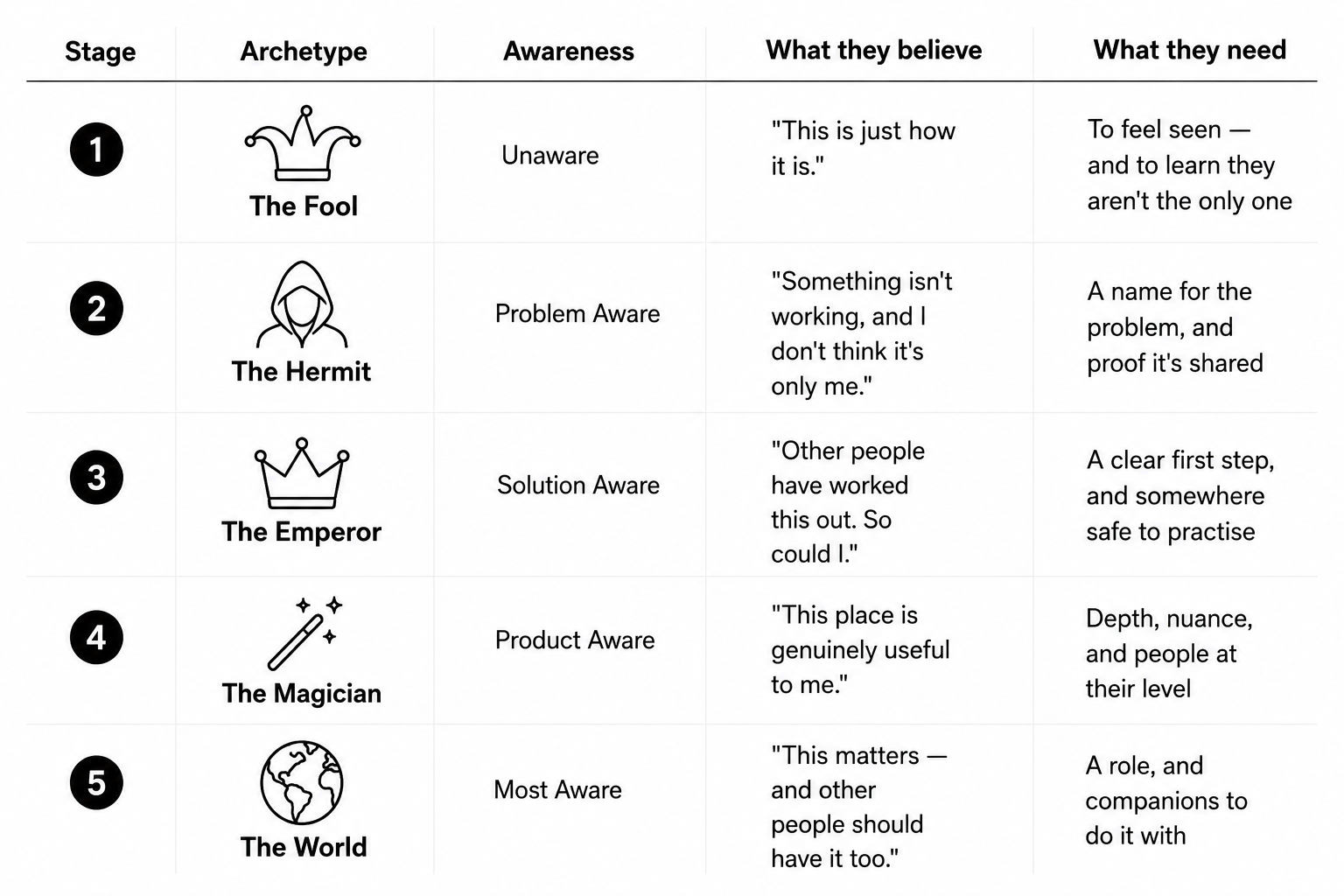
The stages are defined by what a member currently believes, not by how long they've been around — which is why awareness, not tenure, is the right axis. Eugene Schwartz's five levels of customer awareness map cleanly onto community: unaware, problem aware, solution aware, product aware, and most aware. Someone unaware doesn't yet know they have a problem. Someone most aware knows exactly what you offer and is already invested.
Each stage carries a different belief about the world, and the belief is what you're actually working with.
For most practical purposes you can collapse these into two groups: the curious (problem and solution aware) and the hardcore (product aware and most aware). The hardcore are your influencers, and the curious are the people you want to influence (as seen on the page about Serendipity Engineering).
The Fool is unaware, and believes this is just how it is — what they need first is to feel seen, and to learn they aren't the only one.
The Hermit has become problem aware: something isn't working and they don't think it's only them, so what they need is a name for the problem and proof that it's shared.
The Emperor is solution aware — other people have worked this out, so they could too — and needs a clear first step, and somewhere safe to practise it.
The Magician is product aware: this place is genuinely useful to them, and what they want now is depth, nuance, and people at their own level.
The World is most aware, believing this matters and that other people should have it too; what they need is a role, and companions to do it with.
Read down that list and you'll notice the need changes shape entirely. It starts as reassurance, becomes explanation, then instruction, then depth, and ends as responsibility.
Give someone the wrong one and they don't move.
What is the critical transformation?
Every community has exactly one threshold where a member stops consuming and starts participating: and that crossing is worth more than all the others combined. It's usually the move from problem aware to solution aware: the moment someone stops treating their situation as a private condition and starts treating it as something they can act on, alongside other people. Before that crossing, a person receives what you offer. After it, they're using it — and everything downstream becomes possible.
Find yours, name it precisely, and then orient everything you build around making that single transition as fast and frictionless as you can.
Two things follow from taking this seriously. First, your activation metric is the crossing, not the signup — the number worth watching is what percentage of new members make it over, and how long it takes them. Second, most of the effort communities pour into their most advanced members would compound harder if it went to the people sitting one step below the threshold, because that's where the returns actually begin.
The stages after the crossing take care of themselves far more than the ones before it.
Why must your message change at every stage?
Because a message pitched at the wrong awareness level doesn't just underperform — it actively repels. Unaware members reject optimisation language. It sounds like a world they're not in, aimed at someone they're not yet. Experts reject beginner language just as hard, because it signals you don't know who they are and haven't noticed how far they've come.
The same true statement has to be said five different ways:
To someone unaware, say: you're not the only one. That speaks to isolation rather than to solutions, which is the only thing they can hear yet.
To someone problem aware, say: here's what's actually going on — naming something they had already sensed but couldn't articulate.
To someone solution aware, say: here's how people here do it. They're ready for method, not persuasion.
To someone product aware, say: here's what you won't find elsewhere, because depth is the only thing left to offer them.
And to someone most aware, say: help us build it — which moves past personal gain toward shared ownership.
Same truth, five deliveries. The mistake is almost never the claim. It's the altitude.
This is also the most common reason good communities fail to grow. The message isn't wrong. It's aimed at the wrong stage.
Why map the journey to archetypes?
Because a stage described as an archetype is one people recognise in themselves, and a stage described as a funnel position is one they resist.
The five stages run from the Fool to the World: the same arc as any hero's journey, and the reason the awareness ladder feels true rather than clinical.
The Fool sets out without knowing what they don't know. The Hermit withdraws to examine the problem and starts to see the pattern. The Emperor takes control and imposes order through deliberate choices. The Magician has real command of the tools and begins bending outcomes. The World arrives somewhere whole — and turns back toward the people still on the road.
This isn't decoration. It changes what you build. A funnel stage tells you what to sell someone. An archetype tells you what they're going through, which tells you how they need to be welcomed, supported, and respected at that point in the journey. That distinction is the difference between community design and marketing segmentation.
It also explains why the last stage isn't an endpoint.
The World isn't a graduation: it's the moment a member's own journey turns outward and becomes useful to somebody at the beginning of theirs.
Where does customer success belong?
Customer success isn't a chapter in your go-to-market story. It's the whole book. The conventional arrangement treats acquisition as the growth engine and success as the department that keeps people from leaving afterwards — which puts the most valuable relationships in the organisation downstream of the ones you are paying to create.
Invert it. The members who cross the critical transformation and start contributing are your go-to-market: they recruit, they teach the people one stage behind them, and they generate the proof no campaign can manufacture. Growth stops being something you buy at the front and becomes something the middle of the journey produces.
Which is also why community so often sits in the wrong place on the org chart. Because advocacy is the outcome everyone wants, community gets filed under marketing, and the fact that growth is an outcome of community operating inside product and operations gets lost.

What's the difference between the Contribution Journey and the Contribution Lifecycle?
The Journey is the path; the Lifecycle is the clock. The Contribution Journey defines a clear route for people to grow within your community through participation and contribution, from new member to top contributor. The Contribution Lifecycle extends that same path through time — the data-driven understanding of how long it takes someone to go from joining, to contributing at the top, and eventually to "retiring" and opening space for the next person.
Together they let you architect a community sustainably, because between them they answer two questions no single framework does: how members actively contribute to delivering your core value proposition, and how long they will do it for.
Contribution should be defined in steps that are precise, measurable, and achievable. Not "members engage" — but the specific act. Answering a question, hosting a table, reviewing someone's work, making an introduction. If you can't name it, you haven't designed contribution. You've hoped for it.
What does "retirement" mean in a community?
Retirement is the point where a top contributor steps back and opens space for the next one: and treating it as a normal part of the Lifecycle rather than a failure is what keeps a community from calcifying. Nobody contributes at their peak forever. Life changes, attention moves, seasons end. A community that has no concept of retirement quietly develops a permanent aristocracy of whoever was most active in year two, and newer members correctly read the top as closed.
Designing for it changes three things.
Roles become terms rather than titles.
Handover becomes an expected act with honour attached, rather than an awkward disappearance.
And you gain a real measure: how long the trip from newcomer to top contributor actually takes, which tells you whether your pipeline is healthy or whether you've simply been lucky with the same few people.
The best version of stepping back isn't leaving. It's moving from doing the work to making room for whoever does it next.
How is this different from a customer success journey?
The shape is familiar but the direction of value is reversed. A customer success journey moves a person toward getting more out of what you provide; the Community Journey moves them toward creating value for other members. In the first, success means the customer is served well. In the second, success means the member no longer needs you in order to contribute.
There's a structural consequence people miss. On a Business Model Canvas, community usually appears only on the right-hand side — customer segments, channels, relationships, the growth story. But if members are genuinely delivering part of your value proposition, they also belong on the left: key resources, key activities, key partners. That moves them from passive value consumers to active value creators — and into your cost structure, because real contribution requires real investment in infrastructure and interaction design.
In practice it means breaking the wall between the kitchen and the dining room: letting members see far enough into your operations to understand how to create value with you.
How does this relate to the Closeness Circles?
The Community Journey is the Closeness Circles translated into a linear framework, and the Circles are where it came from. If the Circles show you the layers — Core, Inner Circle, Network, Crowd — the Journey shows you how a specific person travels between them, and the Lifecycle tells you how long that takes.
The mechanism is the same in both: wholehearted contribution is what moves someone inward. Which means the Journey isn't a second framework competing with the Circles. It's the Circles made operational for a team, with stages you can name, thresholds you can measure, and invitations you can actually send.
How do you start?
Start by answering three questions well enough that your whole team gives the same answers: what is your key value proposition, in what ways can your community participate in delivering it, and how can you make it easy for members to contribute. Then find your critical transformation, name the specific contributions that count at each stage, and measure how long the crossing takes.
As I wrote in Chapter 17: it is your responsibility as a community builder to create communication systems that build and maintain trust while providing tools to empower people to help your community grow. The job is to enable people to grow your community — and to grow, themselves, in the process.
How this connects to the other frameworks
Closeness Circles — the source. The Circles are the layers; this is the path between them.
Community Design: the 5 Ps — Participation is the P this framework operationalises. The 5 Ps define what contribution is; the Journey gives it a route and a clock.
Interaction Design: Lighthouse, Port, City — every stage of the Journey needs a corresponding activity to step into. The City is where contribution becomes a role.
Engineering Serendipity — your connectors are catalysts. Turning that into a named role is what the Journey does.
The Core Values of Community — the members who cross the threshold fastest are the ones already living abundance, humility, and authenticity before anyone told them the values.
The Dandelion Lifecycle — this is the framework for the Seed Head and Flying stages, when a community is large enough that people need a visible path.
Developed from Hacking Communities: Cracking the Code to Vibrant Communitiesby Laís de Oliveira. Also published in Portuguese as Reinventando Comunidades. The awareness ladder is adapted from Eugene Schwartz's Breakthrough Advertising.
Last updated: 19 August 2026
How the Community Success Journey Connects to Lighthouse, Port, City and Closeness Circles
An integrated framework.
The 5-Stage Success Journey: how a stranger moves from Unaware to Most Aware across the Lighthouse, Port and City phases — and how each stage pulls them closer to your Core. Hacking Communities: Cracking the Code to Vibrant Communitiesby Laís de Oliveira.