What Is Hacking Communities?
Hacking Communities is a book, a practice, and seven frameworks for building communities that sustain themselves — by Laís de Oliveira.
It's an approach to community building that starts from the source code of belonging rather than from tactics: what makes people gather, what makes them stay, and what makes a community able to grow without the person who started it. Learn more about the method applied to growth and go-to-market here.
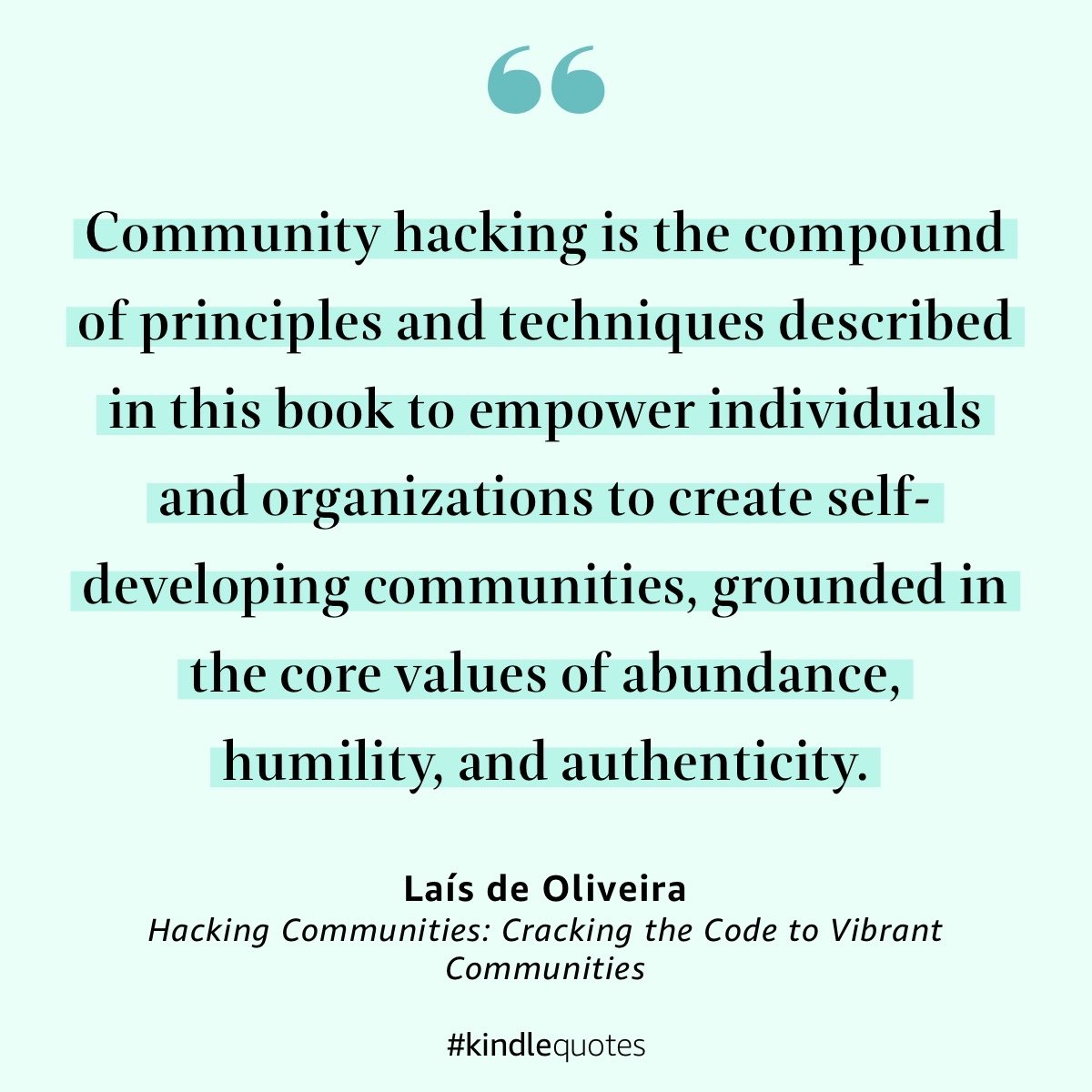
What does "hacking" mean here?
The hack was never a shortcut. It was cracking the code. Hacking a community means going back to the source code of belonging — to the foundational principles underneath it — rather than looking for tips and tricks that skip the work.
There are three parts to it:
Embodying an authentic community leadership style, through a core set of principles, values, and methodologies.
Building a self-sustaining community from a strong core — a source code defined by the values of abundance, humility, and authenticity.
Accelerating trust and creating a collective sense of belonging by bringing people together consistently, and facilitating relationships rather than transactions.
Which is why the book is less practical than its title suggests. As I wrote in the note to the printed edition: while the title alludes to tips and tricks for community building, its content means to equip emerging leaders with the foundations to build self-sustaining communities.
One reviewer put it better than I did. "The reason why it is possible using Oliveira's strategy to hack a community is precisely because she doesn't focus on strategies and tactics for building community. She wants to help you, the person building the community, grow into the mindset of being a community builder."
I wrote it living by the African proverb: give a man a fish and you feed him for a day; teach a man to fish and you feed him for a lifetime.
What is a community?
A community is people sharing (anything) consistently — regardless of their location, nationality, gender, ethnicity, or sexual orientation. Three words are doing the work in that sentence:
People implies a collective.
Sharing (anything) means having something in common — space, ideas, food, needs, ideals. It implies offering, dividing, or being gathered around something.
Consistently means continuous, recurring encounters. It means building a relationship.
The word itself comes from the Latin communitatem, which originally meant fellowship, or a community of relations and feelings, and in medieval Latin came to mean a society or a division of people. What matters is that common sits at the centre of community.
And what brings people together matters far less than why they stay. Community building is like the turkey at Thanksgiving dinner — people gather to eat the turkey, but what matters are the conversations around the table.
What's the difference between a community and a crowd?
Three elements tell you whether what you're building is a community or just another gathering of people — a crowd, a customer base, or a Cool Kids Club. They are Identity, Connectedness, and Growth, and they relate through a formula:
Identity + Connectedness = Growth
Identity is the key element of belonging: people feeling part of something bigger than themselves, which gives them a sense of freedom and safety. It creates value by giving people a platform for self-expression through other people. When we feel part of something, we feel responsible for it.
Connectedness means value flows peer to peer, beyond whatever concrete thing is on offer. Community building is a conversation running in every direction; traditional marketing is a one-sided announcement. The first builds relationships and the second builds transactions.
Growth is what those two produce together, and it's organic. Communities don't grow from one to a thousand. They grow from one person to another — one to two, three, five, twenty-one, fifty-five — in a progression closer to the golden ratio than to a marketing funnel.
Participation is the ultimate evidence that you've built a community: people acting as protagonists, not as the audience.
What is a Cool Kids Club?
A Cool Kids Club is what you get when a group looks like a community but is organised around status and exclusion instead of belonging. It's the anti-pattern, and it's easy to build by accident — gatekeeping, in-group dynamics, pressure to conform, status as the currency, homogeneity mistaken for alignment.
The difference is what people are being asked to do. Belonging doesn't require us to change who we are; it requires us to be who we are. Fitting in is about assessing a situation and becoming whoever you need to be in order to be accepted. One is love-driven. The other is fear-driven. The bridge between them is vulnerability, and any community without a safe space to be vulnerable in will drift toward the second.
Why does community matter now?
Because we are the loneliest generation on record, and loneliness is a health emergency as much as a social one. We are more mobile and more connected than any people who came before us, free to belong beyond our geography, nationality, gender, ethnicity, or orientation — an unprecedented opportunity to build more diverse communities than have ever been possible.
And yet.
Reinventing community means creating safer places for ourselves and for others to feel at home in a world threatened by loneliness. As a community builder, your job is to make other people feel at home: to create spaces where people feel safe enough to take their shoes off, be vulnerable, and express themselves authentically. Home is where we find true belonging.
The first step is feeling at home with yourself. You have to be the first to take the brave step of being vulnerable — which is why the code, it turns out, is personal.
What's in the book?
The book is in two halves. Part I lays the foundations — the case for community, the psychology and evolutionary biology of belonging, the loneliness epidemic, the difference between belonging and fitting in, and the three core values that make community possible at all.
Part II is the practitioner's toolkit — the Dandelion Lifecycle and the frameworks that belong to each of its stages, from finding your core through to letting the community grow beyond you.
It features personal stories, research studies, and creative metaphors collected on my own journey to becoming a community builder — from startup ecosystems in Southeast Asia to a lonely year in San Francisco.
It's also published in Portuguese as Reinventando Comunidades.
What are the Hacking Communities frameworks?
There are seven, and they're not alternatives to one another — each answers a different question, and using the right one at the wrong moment is the most common reason community strategy fails.
The Dandelion Lifecycle tells you where your community is. The Core Values are what it's built from. The 5 Ps are what you design. Interaction Design is what you build. Engineering Serendipity is what happens inside it. Closeness Circles tells you who's close. And the Community Success Journey tells you how one person travels from newcomer to top contributor.
Who is Hacking Communities for?
It's for anyone who has to bring people together and make them want to come back — community builders and ecosystem builders, founders, marketers, product and customer success teams, organisers, and people building something in a place that doesn't have it yet. It starts from the principle that anyone is potentially a community builder.
It is not a book of tactics, and it will frustrate you if that's what you came for. There is no shortcut to community building and no quick hack that takes you from zero to belonging. It's about becoming the kind of person a community can form around.
Where did it come from?
It was ideated in 2014, written through 2018, and first published in 2020, with a printed edition following in 2023 and a Portuguese edition as Reinventando Comunidades. The research behind it spans fifteen years and four continents — interviews with community builders across the fastest-growing startup ecosystems in the world, from Singapore to Stockholm to São Paulo to Silicon Valley, alongside ancient wisdom, social neuroscience, and a lot of Post-it notes.
Today, Hacking Communities is three things at once: a book, a practice, and an ongoing conversation about what it takes to build belonging that lasts.
Hacking Communities: Cracking the Code to Vibrant Communities by Laís de Oliveira. Also published in Portuguese as Reinventando Comunidades.
Last updated: 19 August 2026